|
Takehara Histrical District in Hiroshima
Takehara is a city located in the south-central part of Hiroshima Prefecture. It faces the Seto Inland Sea and is situated between Mihara and Kure. It appears to have long flourished as a key transportation hub on the Seto Inland Sea. It was known as a port town during the Muromachi Age (1336-1573) and later prospered through the salt-making industry during the Edo Age(1603-1868). Takehara retains much of its townscape in the Edo Age to this day and is known as the "Little Kyoto in former Aki Province."The historic townscape of Takehara is located approximately 800 meters north of Takehara Station. Heading north from the station and crossing the Honkawa River, I entered the area featuring the old townscape.
The weather that day was typical of the rainy season, with overcast skies creating a somewhat somber atmosphere throughout the historic district. I made my way from Toba-machi Street toward Honmachi Street. The former KASAI Residence is situated just before the dead end shown in the photo above.
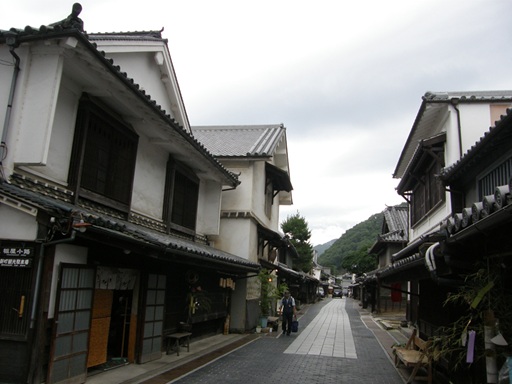
The Former KASAI Residence was built in 1872 as the home of a salt field operator. Turning left at the Former KASAI Residence leads to Honmachi Street. The photo below shows the view upon entering Honmachi Street. |
|
|
|
Along Honmachi Street, old buildings line both sides of the narrow road for a stretch of about 400 meters. Although Takehara's historic district is a maze of narrow lanes, the layout of this particular street appears identical to how it was depicted in a map from 1718. Further ahead on the right, you will find the TAKETSURU Sake Brewery.
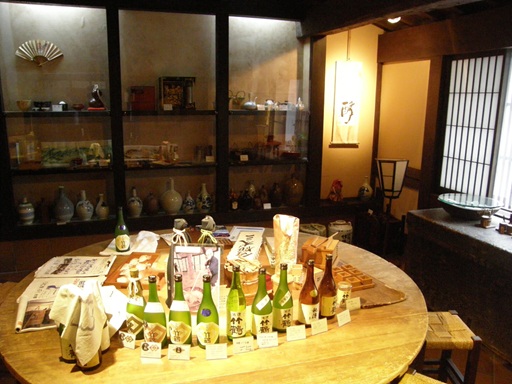
The TAKETSURU family originally operated a salt-making business but reportedly began brewing sake in 1733. It is also the birthplace of TAKETSURU Masataka (1894-1979), the founder of Nikka Whisky.The shop interior is open to visitors, with sake bottles neatly displayed. In recent years, the brewery has frequently won gold awards at the Annual Japan Sake Awards. |
|
|
|
The Former MATSUSAKA Residence is located about twenty meters northwest of the TAKETSURU Sake Brewery.
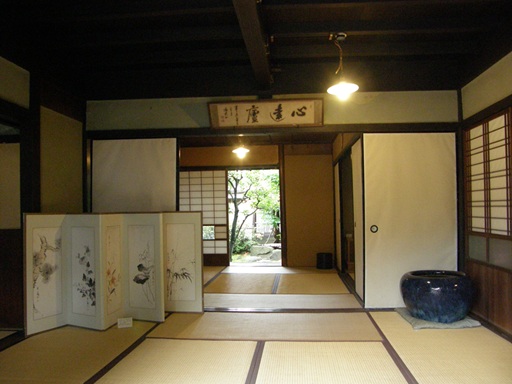
Even in this neighborhood lined with old structures, this building stood out for its particularly imposing presence. It features an "irimoya" roof, hip-and-gable roof, and a "hirairi orientation", eaves-facing orientation, toward the street. Another building is located directly behind it. |
|
|
|
The former MATSUZAKA residence appears to have been the base of a diversified business enterprise; in addition to salt production, the family engaged in the firewood wholesale trade, shipping, and brewing. This implies that many merchants amassed great wealth through the salt industry here, and the salt production in Takehara was highly developed at the time. After leaving the former MATSUSAKA residence, I continued heading northwest. The scenery of the historic townscape continued beyond the residence as well.
About fifty meters along Honmachi-dori Street from the former MATSUSAKA residence, a flight of stairs leading to a temple came into view on the right.
This alleyway possessed a charming atmosphere too. Saiho-ji temple is located at the top of the stairs. Saiho-ji Temple contains Fumeikaku Hall, a structure built in the "kake-zukuri" style, constructed on a raised platform or stilts.
An information board at the temple noted that it was built by KOBAYAKAWA Takakage (1533-1597), modeled after Kiyomizu-dera Temple in Kyoto.Please refer the pages of "Kiyomizudera Tempe in Kyoto" : http://cf916626.cloudfree.jp/HandE_Japan/TravelDestinations/Kansai/KiyomizuderaTemple_E.html From the Fumei-kaku hall, I enjoyed a panoramic view of the Takehara townscape. Houses with black tiled roofs stretched out into the distance.
I returned to Honmachi-dori Street from Saiho-ji Temple. An old building stands on the corner where the lane to the temple meets the main street.
Old buildings continued to line on the Honmachi-dori Street as I walked further along. These old buildings were found not only along Honmachi-dori Street, but also in the backstreets. |
|
|
|
I spent about two hours strolling through this historical Takehara townscape. The area is designated as an Important Preservation District for Groups of Traditional Buildings. It received this designation in 1982 and covers an area of ​​approximately 5.0 hectares. |
|
How to get there
Other Historical Sites near by:
|
Home Page in Japanese: "Shane's HomePage"